Stay healthy
- Recommendations for preventive measures
- Prevention tips and plain-language information
Twelve months of digital prevention for rural residents, on their own phone. myoncare reviews every check, routes findings to local care and gives program owners de-identified data by county.
Rural Americans are more likely to die early from causes that prevention can influence. At the same time, hospitals close and primary care is thin. Prevention has to reach people where they live.
people live in rural (nonmetro) counties, 13.6% of the U.S. population.
USDA ERS, 20261of early heart disease deaths in the most rural counties were potentially preventable, compared with 30.1% in large cities.
CDC MMWR, 2024 (2022 data)2rural hospitals have closed or converted since 2005, 109 of them completely.
Sheps Center, 20263of primary care Health Professional Shortage Areas are estimated to be rural.
Sheps Center, 20264Every participant starts with a personal risk profile. Each month the app covers one health topic with a risk check, support and a result. No travel, no waiting room.
1risk profile to start18health topics7lifestyle factors alongside
Alongside the twelve stages, seven lifestyle topics run all year. Residents choose matching 7-day programs themselves and start them right in the app, free of charge.

Residents screen themselves, local care teams see findings that need attention, and program owners see data by county. Program owners only see de-identified, aggregated data.
Each resident on the map stands for many. Their checks flow into one de-identified regional report, shown only for groups of 10 or more.
are visible only to the resident and their local care team.
sees only de-identified, aggregated data by county or region, never individual data. Reports require a minimum group size of 10 people.
Participation is voluntary and requires each resident's consent.
Reports cover groups of 10 or more people only. Individual results are never visible to the program owner.
screen themselves and see their own results.
a rural health clinic, community health center or telehealth partner sees findings and invites people to follow-up care.
a state, county or health plan receives de-identified reports by county with recommendations.
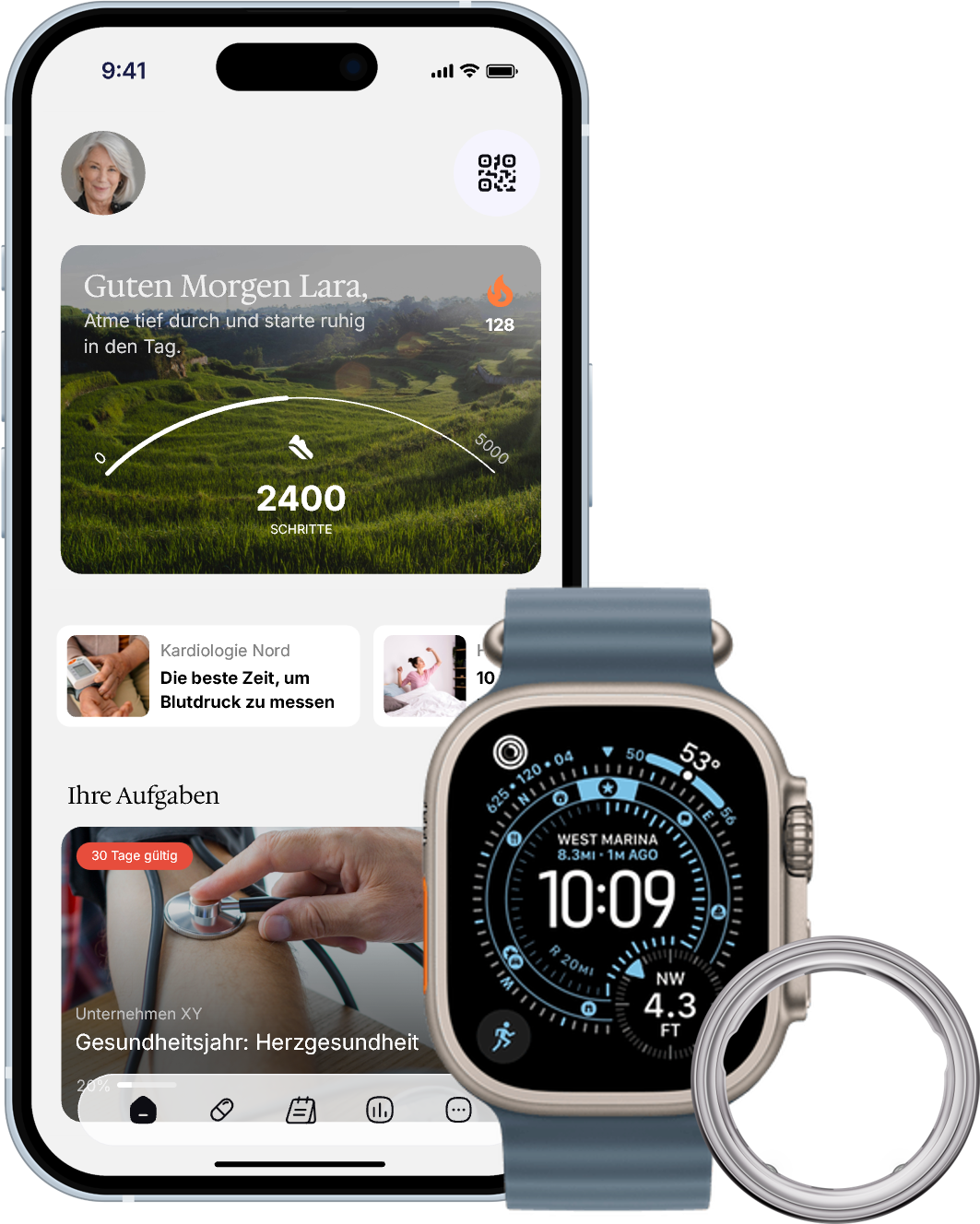
Residents use the Health Year in the myoncare app for iOS and Android or in the browser. Questionnaires, reminders and results arrive at home, without a trip to the clinic.
The Rural Health Transformation Program gives states $50 billion over fiscal years 2026 to 2030. Two of its eleven permitted uses describe what the Health Year does.
States must use funds for at least three of eleven permitted uses. Two fit directly: prevention and chronic disease management, and consumer tech solutions such as apps for preventing and managing chronic disease. First-year awards averaged about $200 million per state.
KFF, 20265State offices of rural health and county health departments can offer the Health Year to all adult residents of a region, with reporting by county.
Set-up agreed per programState Medicaid agencies, managed care plans and other health plans can include it in prevention and care management programs for rural members. Rules vary by state.
Review per state and planCritical access hospitals, rural health clinics and community health centers can use it to reach patients between visits and as part of community health programs.
Set-up agreed per programNot legal or funding advice. Whether the Health Year fits a state's approved RHTP plan depends on that plan. We review the options with you.
Four inputs give a first estimate for your region. The model shows reach, cost and a transparent break-even. It does not promise savings.
Pricing: Billed per participant per month, so the program owner pays only for residents who take part. The $5 price used here is indicative.
Illustrative model. Break-even shows how many avoided stays would offset the program cost. It is not a forecast.
| Input | Assumption | Basis |
|---|---|---|
| Adults in the region | Default 50,000 | Example region of several rural counties; rural (nonmetro) population in total: 46.2 million1 |
| Participation | Default 20% | Own assumption. Conventional wellness programs often reach fewer than 20% of those eligible7 |
| Completion | Default 60% complete all 12 stages | Own assumption; other participants count with half the stages |
| Price | $5 per participant per month | Indicative myoncare price; quote on request |
| Cost per preventable stay | Default $9,500 | Mean cost of 3.5 million potentially preventable adult stays in 2017 ($33.7 billion in total)6 |
| Reference rate | About 16 potentially preventable stays per 1,000 adults per year in the most rural (noncore) areas | 1,596 per 100,000, age- and sex-adjusted, 20176 |
Formula: Participants = adults × participation. Program cost = participants × $5 × 12. Topic checks = participants × 12 × (completion + (1 − completion) × 0.5). Break-even stays = program cost ÷ cost per stay.
Deliberately not included: emergency visits, travel time and costs, lost productivity, long-term effects and any savings estimate. The reference rate is for orientation only; it does not say how many stays the Health Year avoids.
Who runs the program decides which rules apply. These are the questions program owners, counsel and privacy officers usually ask.
Participation is voluntary and requires consent. Program owners receive de-identified reports for groups of 10 or more only.
myoncare program designOffered by a health plan or a covered health care provider, the data is protected health information under HIPAA. Other set-ups may fall under state health privacy laws instead.
HHS8Some states have their own consumer health data laws, for example Washington's My Health My Data Act. We review the set-up for your state.
Washington State Attorney General9myoncare reviews checks and routes findings. Diagnosis and treatment stay with the local care team that the program defines.
myoncare program designThis overview is not legal advice. We review the set-up with you and your counsel.
Counties, target groups, funding route and how success is measured.
Clinics, community health centers or telehealth partners that receive findings and invite people to follow-up care.
QR codes in clinics, pharmacies and libraries, local media and community events. We provide the materials.
De-identified reports by county for steering the program and for program reporting.
State offices of rural health, county health departments, Medicaid agencies, health plans and rural health systems. The program owner defines the region, the target groups and the local care partners.
No. Individual results are visible only to the resident and the local care team. Program owners receive de-identified, aggregated reports for groups of 10 or more people.
The local care partners defined in the set-up, for example a rural health clinic, a community health center or a telehealth partner. myoncare routes the finding; clinical decisions stay with them.
Prevention and chronic disease management and consumer tech solutions for chronic disease are permitted uses. Whether the Health Year fits depends on your state's approved plan. We review this with you.
Pricing is per participating resident per month, so you pay only for people who take part. The estimator above gives a first figure; we prepare a quote in the first call.
Yes. Participation is voluntary and requires each resident's consent.
Yes. The topics, the app and the lifestyle programs are the same. The rural set-up adds local care partners and reporting by county. See the Health Year overview.
The Health Year runs on the myoncare platform, developed by ONCARE GmbH and offered in the U.S. by myoncare, Inc.
The standards and certifications listed refer to the quality management system (QMS) and information security management system (ISMS) of ONCARE GmbH, which is responsible for developing the myoncare health platform. More on quality & security

In 30 minutes we show you the app, the regional report and the topic plan, and estimate reach and cost for your region.